
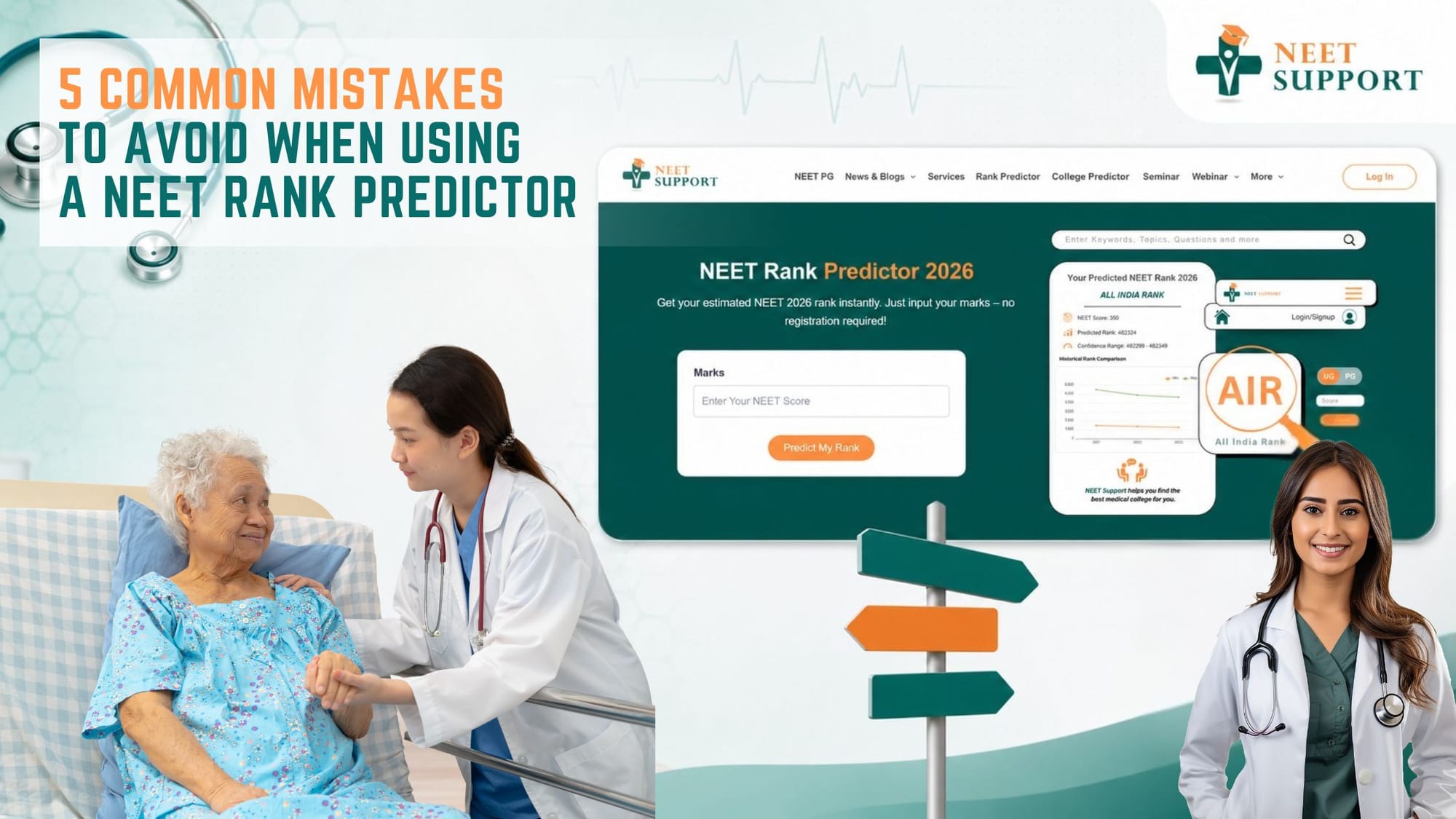
5 Common Mistakes To Avoid When Using A NEET Rank Predictor
Nishat
 WhatsApp
 Email
Email Facebook
 Twitter/X
 LinkedIn
Table of Contents
Predict Your Rank Now
Enter your NEET score to get an estimated rank
Find the Best Colleges For You
Based on your NEET rank, Category & more

Get Your Dream Medical College
Secure your seat with expert counselling
The days after the NEET UG exam are full of waiting and endless calculations. While you wait for the NTA to release the official results, your mind naturally turns to one big question: “Which medical college can I get into with my score?”
Online NEET rank predictors are great tools to help estimate your All India Rank (AIR) and start building a rough college list. However, a rank predictor is only as accurate as the information you give it. Many students make simple mistakes during this stage that lead to unnecessary stress or false hope.
To make sure you get the most accurate results, here are five common mistakes to avoid.
1. Entering Unrealistic Marks
The most common mistake happens before the tool even calculates a result: entering an incorrect expected score.
When calculating your score using unofficial answer keys, it is easy to get overly optimistic. You might give yourself the benefit of the doubt on borderline questions, or forget to deduct the $-1$ penalty for negative marking on wrong answers.
The Hidden Risk:
In NEET UG, a difference of just 5 to 10 marks can shift your rank by thousands of positions, especially if you are scoring above 600. If you type in an inflated score, the tool will give you a highly optimistic rank. When the real results come out, the sudden drop can completely ruin your counseling strategy and leave you unprepared.
The Fix: Be completely honest with your calculations. Calculate a worst-case scenario and a most likely average. Input your conservative score into the predictor. If a college shows up as reachable with that lower score, you can trust it as a genuinely safe option.
2. Ignoring Category Rules
NEET UG counseling depends heavily on reservation quotas. A major error is looking only at the general All India Rank and assuming it applies to everyone, or picking the wrong category from the tool's menu.
The closing ranks for the same medical college change drastically between different categories:
- General / Unreserved (UR)
- Other Backward Classes (OBC-NCL)
- Economically Weaker Sections (EWS)
- Scheduled Castes (SC)
- Scheduled Tribes (ST)
- Persons with Disabilities (PwD)
The Hidden Risk:
If you belong to a reserved category but look only at open merit data, you might miss out on excellent government colleges where you have a strong chance. On the flip side, if you select a category like OBC without holding a valid, central-format certificate, your predicted cutoffs will be completely useless during real counseling.
The Fix: Double-check that you are selecting your exact category. Also, remember that some states have unique local quotas (like defense or freedom fighter quotas). A standard online predictor might not show these, so use the tool as a broad guide rather than the absolute truth.
3. Confusing All India Quota and State Quota
Medical seats in India are split into two major pools: the 15% All India Quota (AIQ) managed by the MCC, and the 85% State Quota managed by your home state's authority.
A good rank predictor tries to show where you stand, but many students fail to realize that their rank behaves differently in these two separate systems.
The Hidden Risk:
States like Rajasthan, Uttar Pradesh, and Delhi have massive competition. In these areas, the state quota cutoff can sometimes be just as high as the national AIQ cutoff. Meanwhile, states like Karnataka or West Bengal might have lower state cutoffs compared to AIQ. If you use a basic predictor that doesn't clarify which quota it is showing, you will miscalculate your chances.
The Fix: Use predictors that let you filter results by both AIQ and specific State Quotas. Never assume that a "seat available" signal for an AIQ prediction guarantees a seat in your state counseling, or the other way around.
4. Forgetting That Trends Change Every Year
A rank predictor is a data-matching program. It looks at your estimated score, compares it to the previous year's trends, and gives you an output. The mistake is forgetting that NEET trends shift every single year.
A score of 610 might have secured a great government seat one year, but due to an easier paper or more students, that exact same score might fetch a much lower rank the next year.
Key factors that cause these shifts include:
- Paper Difficulty: An easier exam pushes average scores higher, causing massive rank inflation.
- Number of Candidates: With the number of applicants growing annually, competition for every single mark increases.
- New Colleges: The opening of new government medical colleges can cushion rank drops by adding hundreds of new seats.
The Hidden Risk:
If you rely on a tool that uses old data without factoring in current student numbers or paper difficulty, you are looking at a flawed picture.
The Fix: Focus on the predicted rank range rather than the marks. When researching colleges, always look at the closing ranks from previous years. Marks change based on paper difficulty, but ranks remain a much more stable indicator of your actual chances.
5. Treating the Prediction as an Absolute Guarantee
The biggest mistake is a psychological one: letting a rank predictor give you a false sense of security or making you give up too early.
Some students see a positive prediction, assume their admission to a specific college is 100% locked in, and stop doing any further research. They fail to look into college bond conditions, annual fees, or hospital choice-filling strategies.
The Hidden Risk:
A computer program cannot predict human behavior. It cannot be known if top-ranking students will suddenly prefer a newly upgraded hospital over an older one this year. It also cannot predict mistakes made by other candidates during actual choice-filling. If you don't build a wide, realistic preference list because a website told you that you were "safe," you risk losing out entirely during real counseling.
The Fix: Use rank predictors purely as a shortlisting tool. Use the results to build a list of 30 to 40 colleges divided into three brackets: Dream Colleges (slightly out of reach), Realistic Targets (highly likely), and Safe Bets (guaranteed backups).
To know What is the NEET Rank Predictor- Read
FAQs
How accurate are online NEET rank predictors?
Online predictors are statistical tools based entirely on data from previous years. While they offer a highly reliable baseline estimate if the exam difficulty remains similar, they cannot predict sudden, real-time rank inflation caused by easier question papers or a surge in high-scoring students.
Should I rely on closing marks or closing ranks when researching colleges?
You should always rely on closing ranks. Cutoff marks fluctuate drastically every year depending on the difficulty of the paper and the overall performance of the candidates, whereas the actual closing ranks of colleges remain far more stable and consistent year after year.
What is the difference between All India Quota (AIQ) and State Quota closing ranks?
The 15% AIQ open seats generally have much higher closing ranks because students from across the country compete for them uniformly. The 85% State Quota seats are reserved exclusively for domicile students of that state, often leading to lower cutoffs, except in highly competitive states like Delhi or Rajasthan.
How does negative marking affect the rank prediction process?
Even a tiny 5-mark error due to miscalculating negative markings can drop your actual position by thousands of ranks. If you enter an overly optimistic score into a predictor without strictly penalizing your incorrect answers, the tool will generate a highly inaccurate and misleading rank.
Will a rank predictor account for new medical colleges opening this year?
No, standard online rank predictors cannot accurately account for newly approved medical colleges or sudden seat increments for the current academic session. These seat matrix expansions cushion rank drops in real counseling, making your actual chances slightly better than what a tool predicts.
When is the best time to use a NEET rank predictor?
The most effective time to use these tools is immediately after the NTA releases the official institutional answer keys. This allows you to calculate your final score with high precision, giving the predictor the accurate data it needs to generate a reliable rank range.
What is the single biggest mistake to avoid after getting a predictor result?
The biggest mistake is treating the predicted rank as an absolute, locked-in guarantee and stopping all your personal research. A predictor is merely a helpful guide; failing to understand the actual counseling rules, documentation, and choice-locking procedures can cost you a seat.
Conclusion: The Smart Way Forward
There is absolutely nothing wrong with using NEET rank predictors to ease your anxiety and kickstart your post-exam planning. They are excellent for giving you a baseline structure, but you must always remember that they are statistical estimation tools, not the final verdict.
While you wait for the official NTA scorecards to drop, use this waiting period constructively rather than checking the predictor tool over and over again. Take the list of colleges suggested by the tool and cross-verify them with the official closing rank PDFs from the previous year, which are publicly available on the MCC and your state DME websites.
Look into the practical details of those colleges: check their annual tuition fees, understand the state bond penalties, and look at the clinical exposure or stipend structures. By balancing automated predictor tools with your own careful, manual research, you will eliminate guesswork, avoid costly errors, and be completely prepared to navigate the actual counseling rounds like a pro.
Also Read - Is It Safe to Share Your NEET Roll Number on Free Rank Predictors?
Reviews
No reviews yet. Be the first to write one!